CONCRETE & OUTDOOR GUIDES
Key Drainage Considerations for Durable Concrete Driveways in Louisville
Planning a concrete driveway starts with understanding your property. Learn what to observe, which drainage questions to ask, and how to discuss preparation, finishes and access with your contractor in Louisville.
Drainage deserves attention before you replace or install a concrete driveway. Start by explaining where water collects, how you use the driveway and what you want to improve. Then ask your contractor to assess the site, its connections and the proposed water-management approach. A useful plan considers more than the concrete surface alone. This guide helps Louisville homeowners prepare for that conversation and make informed decisions about a long-lasting concrete driveway without relying on a universal construction recipe.
Begin with what happens at your property
Describe the concerns you can actually observe. Water may collect near the garage, remain beside an edge or move across the driveway from another part of the property. Explain when you notice it and whether the situation has changed. Those observations help the contractor decide what needs a closer assessment.
Take overview photographs when the area is safe to approach. Include the driveway, nearby ground, downspouts and entrances. A close-up of a puddle is useful, but it does not show the whole route water takes. Avoid walking into standing water or entering a drain to gather information.
Look beyond the new concrete
Show how the driveway connects to the garage, street, walkways and landscaping. Mention planned changes such as a new patio or planting bed. Discuss any existing drain, channel or low area that may affect the layout. A replacement driveway should be planned in the context of the surrounding property.
Louisville MSD describes stormwater moving through drainage features such as swales, channels, drains and pipes. It distinguishes public drainage from private drainage and explains that its responsibilities do not cover every drainage concern on private property. This is a reason to identify the issue and the appropriate contact before assuming a solution.
Ask whether your project needs coordination with a local authority or another qualified professional. Do not assume that an existing outlet, street connection or neighboring area is an approved place to redirect water. Your contractor should explain what needs confirmation for the proposed work.
Ask for an assessment of the existing ground and base
Soil and site conditions need to be assessed at the property itself. A general description of Louisville cannot establish what is beneath your particular driveway. Tell the contractor about previous repairs, settling, excavation or drainage work that you know about. Old project records can be helpful when they are available.
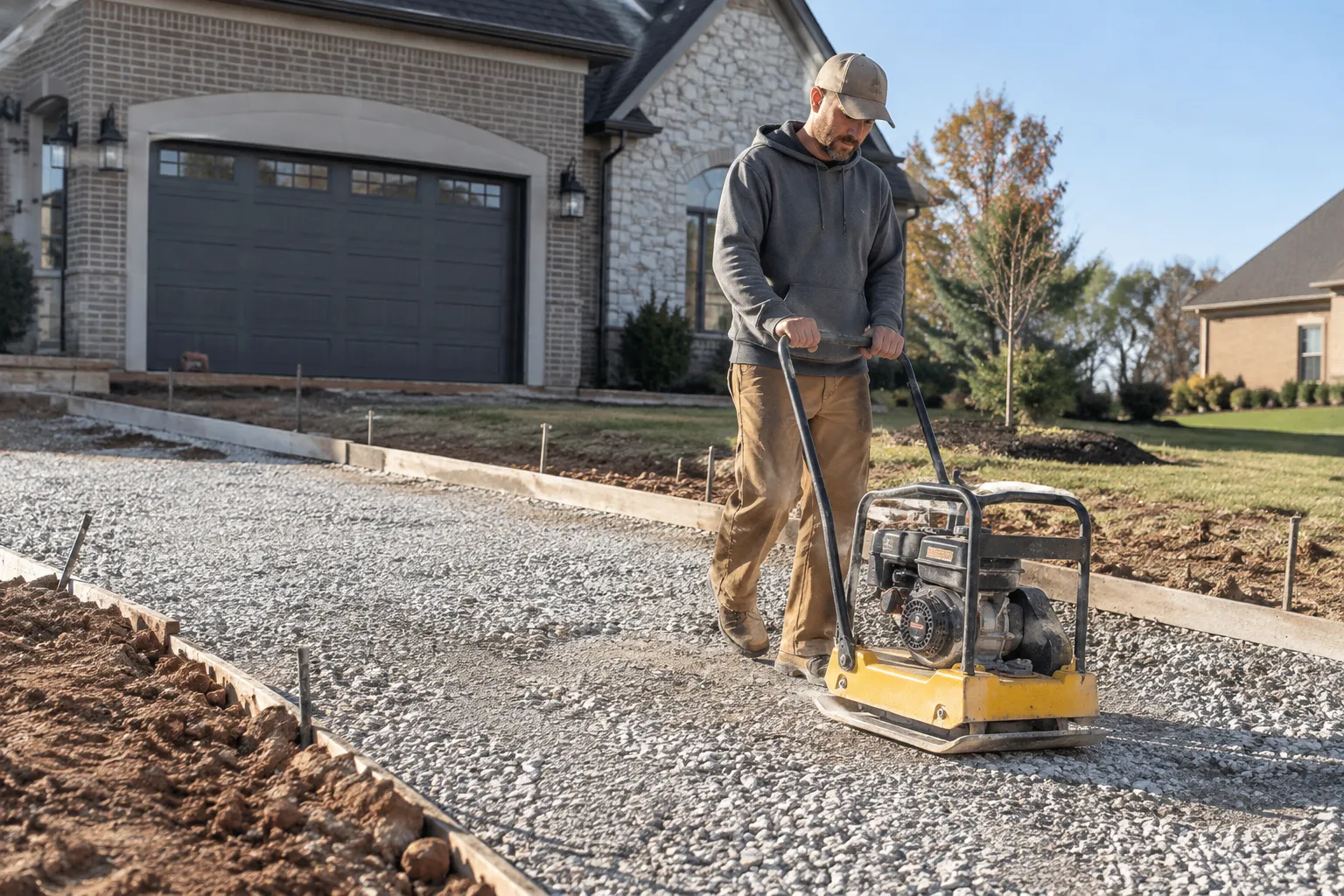
Base preparation should match the site and expected use. Ask how the ground will be evaluated, which materials are proposed and how preparation will be checked before concrete placement. A standard number copied from an article is not a substitute for that assessment.
Discuss the proposed water-management approach
Ask the contractor to explain how water is expected to move across and around the finished driveway. Request an explanation of the connections at the garage and other adjoining surfaces. If an additional drainage feature is proposed, discuss where it leads and what access will be needed to maintain it.
Different properties may need different approaches. A particular drain type or layout should not be selected simply because it worked at another house. Ask why the proposed option suits your situation, which concerns it addresses and whether anything falls outside the driveway project's scope.
Keep concrete design and finish decisions connected
Drainage, concrete specifications and the finish should be discussed as parts of one project. Tell the contractor about the vehicles that normally use the driveway and any planned change in use. Ask how those details affect the proposed work and what is included in the estimate.
Ask how joints will be planned for the actual slab layout and connections. Their placement needs a project-specific explanation, rather than a spacing rule applied to every driveway. Also compare the maintenance and practical use of different finishes. Decorative stamped patterns are an appearance option to discuss alongside those requirements.
Make the estimate clear before work begins
A useful estimate helps you understand what will be removed, what preparation is included and how the finished driveway connects to existing areas. Ask how unexpected conditions discovered during removal will be handled. Confirm which drainage concerns are part of the work and which require a separate assessment.
Discuss access during construction, where vehicles can park and how changes will be communicated. Ask for instructions about returning to use and any finish or sealer care. Follow the guidance for your actual concrete, weather conditions and intended loads rather than a general waiting period.
Keep useful records after the project
Save the estimate, product information and maintenance instructions. Take photographs of the completed layout so you have a reference for later questions. If you notice a change, describe its location and when it appears. Contact the contractor for an assessment instead of adding a treatment or altering drainage without guidance.
Common questions
Does every driveway need the same base or drain?
No single arrangement suits every site. Ground conditions, existing connections and intended use should inform the proposed preparation and drainage approach.
Can new concrete resolve every water problem?
A driveway project may address some concerns, while others need separate work or review. Ask what the proposed plan is intended to address and what remains outside its scope.
What information helps with an estimate?
Provide your city or ZIP code, overview photographs and a description of water concerns. Include normal vehicle use and any earlier repairs or drainage changes you know about.
Explore Concrete Slabs & Driveways or request a free estimate to discuss your property.
Local reference
Louisville and Jefferson County Metropolitan Sewer District: Stormwater Drainage. louisvillemsd.org